
Dyscalculia: When Our Kids’ Numbers Won’t Math



Dyscalculia is a lot more common than we think. We often just find out about it when we’re adults!
If dyslexia is the learning disability for reading, then dyscalculia is the one for math. Numbers, properties of equations, constants, equivalents, geometric theorems, and even the operations are difficult enough for even an adult to recall on instinct. But the struggle with math starts early on in childhood. Maybe they can recite the numbers by memory, but to understand what one means or what 1+1 feels outlandish to them.
Here’s what else we know about Dyscalculia:

Dyscalculia isn’t a new thing
The learning disability was discovered in 1919 by a neurologist, Salomon Henschen. He discovered that some individuals, despite being able to do everything else, struggled with numbers or anything associated with them. It was first called “number dyslexia” or “number blindness” before finally earning its name in 1974 as “dyscalculia.” The name was coined by Czech researcher Ladislav Kosc. He described it as “a learning disability characterized by difficulties with mathematical performance despite otherwise normal cognitive functioning.”
In other words, everything but numbers was easy to understand.
It usually shows when kids are 6 to 9 years old
According to the Cleveland Clinic, dyscalculia usually accompanies mental health disorders like depression and anxiety in kids. After all, what kind of kid wouldn’t panic if they don’t understand why the six suddenly flipped into a nine or why the three candies suddenly turned into six?
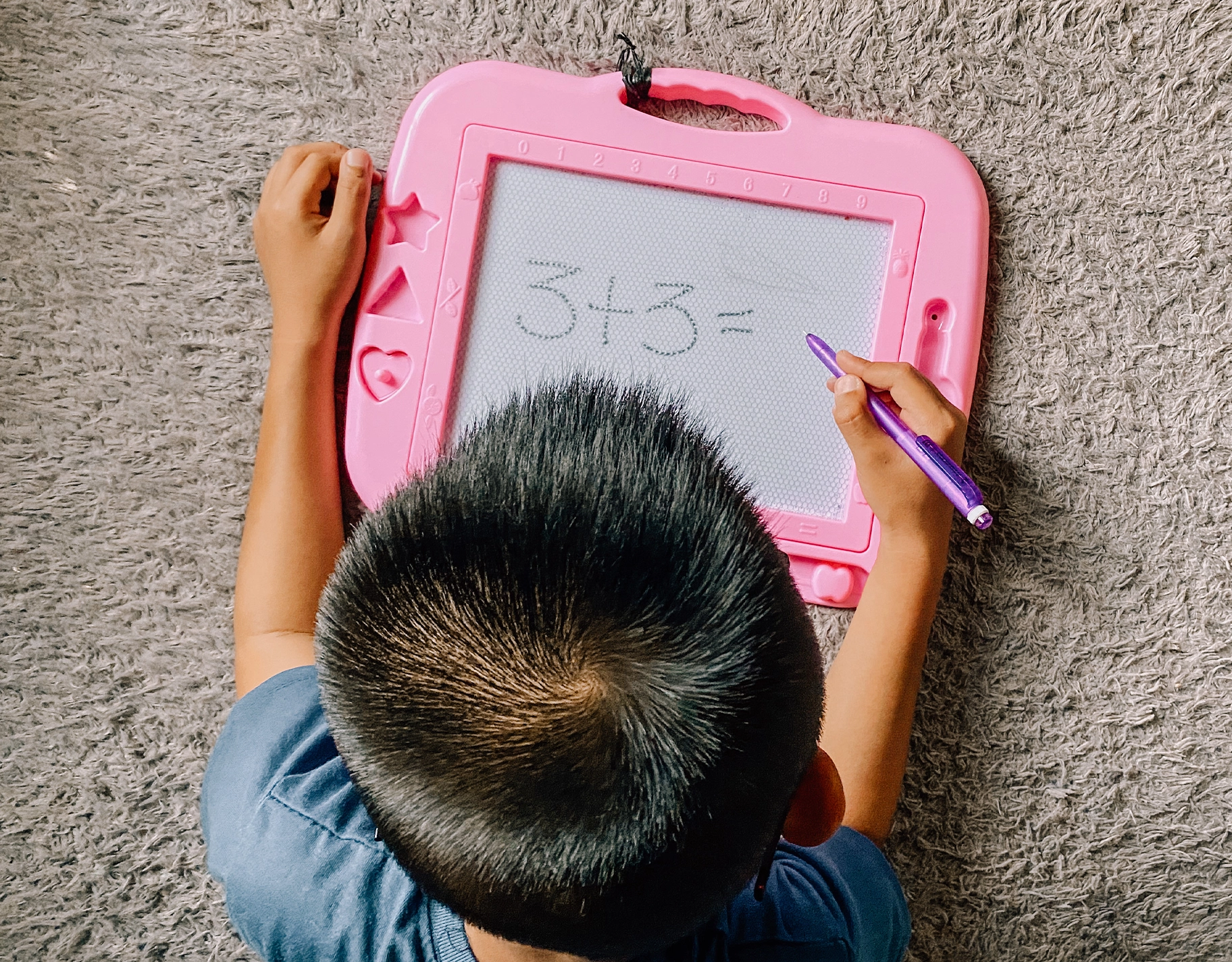
It usually shows when kids can’t count upwards or struggle to understand what the plus, minus, division, and multiplication signs mean. They also struggle in trying to count and estimate with their eyes and comparing amounts. Eventually, without proper interventions, it can affect bigger things in life like their ability to handle money, measure quantities, and solve word problems.
Dyscalculia is said to have a genetic component
Some believe that dyscalculia, like most learning disabilities, runs in the family. However, studies haven’t really found which gene contributes to it yet. Nor have they figured out which parent it comes from. A study revealed that the disability may come from the gene myosin-18B, but warned that it may only contribute. Its mutation or change isn’t the main cause (Ludwig et. al, 2013).
However, they did point out that if a child has it — their parent or sibling may have it also.
Those with dyscalculia are very aware of their disorder
Nothing is worse than being aware and being forced to accept that we’re handicapped in a way that others are not. As adults, we can easily say, “Eh, maybe it’s not for me.” But kids don’t have that when they’re in school. Whether they can do it or not, they have to soldier through math class. Even if the numbers look like they’re doing somersaults over their teacher’s head or the plus sign feels like some strange mystical symbol from another universe (Mahmud, Zainal, Rosli, and Maat, 2020).
So when our kids struggle with math, follow their pace. While numbers are concrete, they still require a bit of imagination to fully understand the impact of these figures.
Anyone can get dyscalculia
We know the running gag and stereotype that Asians are supposedly good at math. But dyscalculia knows no race nor gender. It can hit anyone and everyone, even those who may not originally have the gene. Why? Well, genes do mutate, and there’s no way to fully predict how they’ll present themselves. However, that doesn’t mean we can’t minimize the effect dyscalculia has on one’s life. That’s what summer and remedial classes are for!
People with dyscalculia can still get math-related jobs!
Just like how people with dyslexia can still be good teachers and live full lives, people with dyscalculia can still achieve in math and number-related jobs. Some interventions involve framing the numbers differently so that it’s easier for them to process. Constant practice in doing so makes it instinctive so it doesn’t look too obvious unless they’re under a great deal of stress.
The famous mathematician Albert Einstein was rumored to have dyscalculia, but he made it anyway!
Math shouldn’t be the ultimate cornerstone metric
While we all acknowledge that our kids’ abilities to handle numbers are a developmental milestone, it isn’t the only one. Someone who can’t do math isn’t someone who won’t succeed. Maybe they have a place elsewhere. It may be frustrating for many of us who were punished heavily for not understanding math when we were kids, but that’s because dyscalculia wasn’t well-documented yet.
So, if ever our kids struggle in math, it doesn’t mean they’ll never succeed. They just need a little help. Summer classes, online tutors, school-sponsored remedial classes — there are so many resources to choose from! All we have to do is figure out which one fits our kids the best.
References
Ludwig, K. U., Sämann, P., Alexander, M., Becker, J., Bruder, J., Moll, K., … & Czamara, D. (2013). A common variant in myosin-18B contributes to mathematical abilities in children with dyslexia and intraparietal sulcus variability in adults. Translational psychiatry, 3(2), e229-e229.
Mahmud, M. S., Zainal, M. S., Rosli, R., & Maat, S. M. (2020). Dyscalculia: What we must know about students’ learning disability in mathematics. Universal Journal of Educational Research, 8(12B), 8214-8222.
Messina, A., Potrich, D., Perrino, M., Sheardown, E., Miletto Petrazzini, M. E., Luu, P., … & Vallortigara, G. (2022). Quantity as a fish views it: behavior and neurobiology. Frontiers in Neuroanatomy, 16, 943504.
More about school and struggles?
10 Important Things Parents Need to Know About Dyslexia
10 Things About ADHD Parents Must Know
Adulting With ADHD or Autism: Coping in the Typical World