
How To Encourage Critical Thinking in the Era of AI



As the use of AI becomes the norm, many teachers and even parents worry that their kids are losing their critical thinking skills
“Critical Thinking” has often been the problem in the Philippines. All the more now in the era of AI, many educators have been scrambling for ways to help kids develop their critical thinking.
AI has reduced the slack on a lot of things. Many businesses saw AI as a way to “downsize” their human-powered workforce, keeping only those who know how to use the former. Families, on the other hand, had started relying on AI as a generator—the extra time gained would be used to spend time with family or do something more wellness-oriented.
Unfortunately, like any tool, some eventually become too dependent on it. Here’s why we shouldn’t be:
Artificial Intelligence: A Tool That Needs Continuous Update
We call it “artificial” simply because it’s man-made. But the concept of intelligence is different; psychologists have defined it over the years of studying human development.
Charles Spearman, in 1904, proposed a basic definition of intelligence. Calling it “General Intelligence,” it describes a core, underlying mental ability that affects performance on all cognitive tasks.
Alfred Binet, in 1905, created what would be the foundation for most intelligence tests. The test, known as the Stanford-Binet, worked with the definition of intelligence being: “a malleable, multi-faceted capability involving reasoning, judgment, memory, and abstraction, rather than a fixed, innate trait.”
Raymond Cattell, in 1940, built on the theory by splitting General Intelligence into two kinds: Fluid and Crystallized intelligence. Crystallized is the typical trivia and terms, while Fluid is the one that brings them altogether.
The three aforementioned definitions have often served as the foundation that many developers have been trying to digitize. But what many developers and AI struggle to do is to mimic the processing of the human mind, one that can handle multiple operations upon instinct and subconsciously. This is why developers describe AI’s information gathering as “scraping”—getting only the surface or lifting words from sources found on the internet.
What Many Families Need To Know About AI’s “Knowledge”
Let’s be honest, AI offers quite the convenience. Especially with the mental load everyone seems to be having nowadays, we turn to AI to handle that. It offers the extra processing power we need while we’re handling all the “real life” matters.
Parents have used it like Google, or sometimes, they use it to generate things when all their personally-constructed emails, texts, work outputs, and posts on their social media feel and sound like “brain fart.”
Kids rely on Google as the ultimate “cram” tool. Hate writing an essay? Just dump it in AI. Sounds too robotic? Find another AI to “humanize” it (Shukla, Tiwari, Gupta, Goswami, and Kulshreshtha, 2021; Amiri, 2025; Bautista and Carrao, 2025; Esparrago-Kalidas et. al, 2025).
A study in the Philippines published in 2024 revealed that the most commonly used AI among students includes ChatGPT, Gemini, and several unlisted others like Cici and CoPilot (Villarino, 2024). Out of 451 students, 176 students declared using AI over “multiple times” in a week.
Unfortunately, many forget to ask: where does AI get its knowledge? From the one place everyone else usually does: the internet! The problem is, if the internet is full of junk and useless content, AI’s output will also be worthless. We also haven’t factored in two possibilities: 1) AI cannot read every kind of file type yet, and 2) not every source of information has been uploaded to the internet.
This Is Where Critical Thinking Needs To Comes In
So, unfortunately, AI will screw up. As long as humans make it, there will be mistakes. It’s annoying since AI was supposed to do the heavy lifting for us, including fact-checking. But some users have reported that AI tends to “hallucinate”—which sometimes causes what some call AI Psychosis.
Even ChatGPT disclaims in its UI, whenever a thread is started, “ChatGPT can make mistakes. Check important info.”
It’s why several government agencies and organizations in the Philippines have been trying to lay down the ground rules for the ethics of using AI. While UNESCO and Global AI Council Philippines have established some principles, the University of the Philippines has posted some of these principles on its website:
- COMMON GOOD. AI should benefit the Filipino people in particular, and humanity, in general, by fostering inclusive economic growth, effective governance, sustainable development, and enhanced well-being while protecting the environment. AI systems should further the rule of law, human rights, and democracy.
- EMPOWERMENT. AI should promote self-determination and bolster the capacity of humans to shape their future. Particularly, AI must empower vulnerable and marginalized groups.
- CULTURAL SENSITIVITY. AI systems must be culturally responsive and culturally sustaining. Cultural norms, values, beliefs, and practices of users must be respected in designing, developing, and deploying AI systems.
- PRIVACY. AI systems must incorporate privacy-by-design principles. Informed consent from users and maintaining the confidentiality of personal information must be upheld when users provide information and when the system collects information about the users.
- ACCOUNTABILITY. Individuals, groups, departments, institutes, colleges, and constituent universities involved in the development, deployment, and use of AI must take responsibility for the consequences of their actions. UP shall put into place mechanisms to hold the relevant stakeholders accountable for the AI systems’ actions and outcomes.
Critical thinking in using AI often has us asking these questions. It’s kind of like that four-way test that we see on walls or placards whenever we go around the Philippines.
How To Critically Think with AI
Now comes the hard part: “How do you do that when AI’s supposed to do the work for you?”
A Facebook page known as Educators Technology revealed a list of activities, prepared by Med Kharbach, that teachers can give their students.
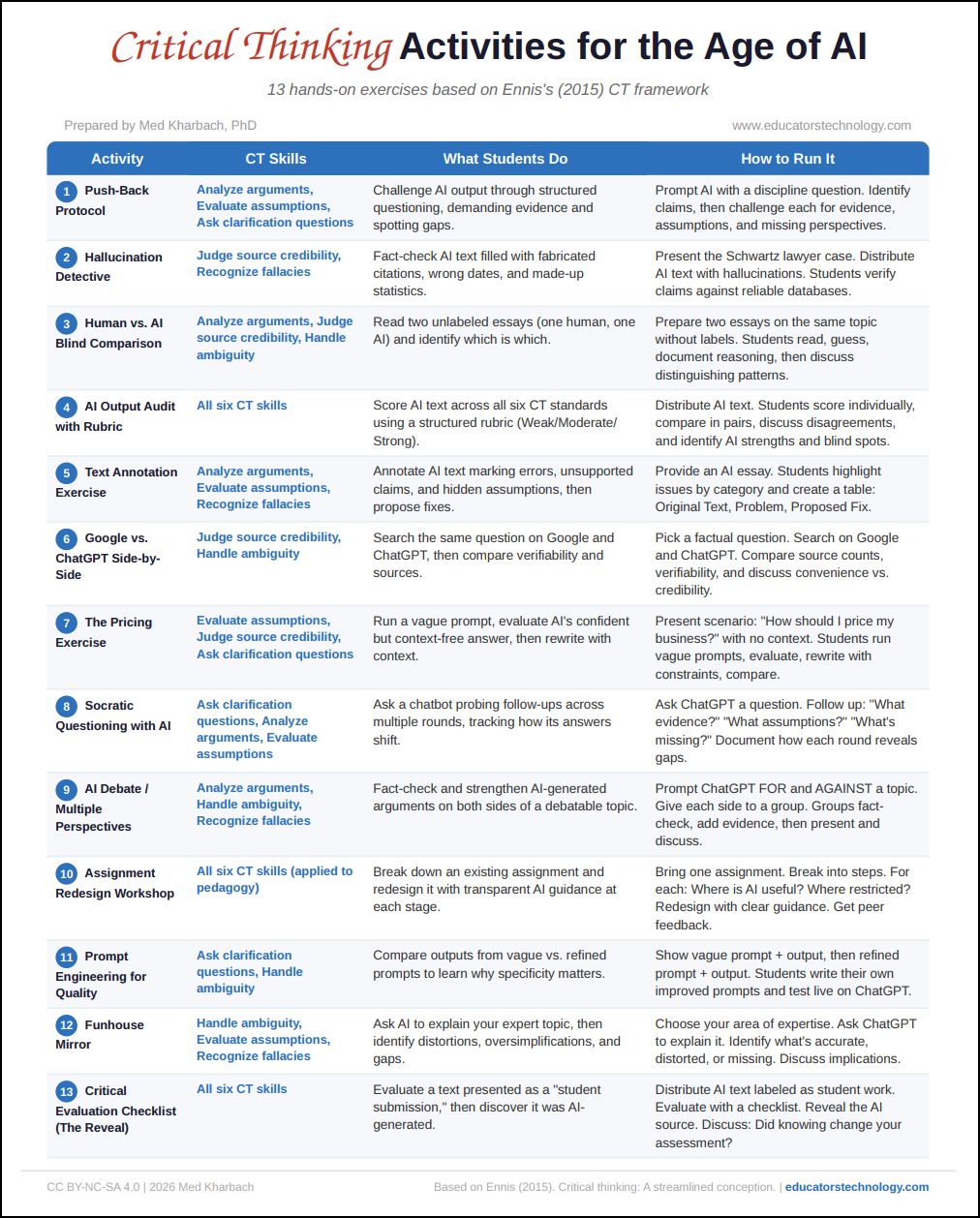
As adults, we can also do this whenever interacting with AI. Remind our kids to do the same thing because sometimes, they just take whatever AI says is law.
AI Is A Tool, Not A Lifetime Crutch
While AI offers the convenience of getting things done immediately, we subconsciously have turned it into a crutch. We struggle to create things ourselves because some of the things AI has produced have become the standard. The level of “perfection” that many have been dazzled by can leave us feeling unsure of ourselves and our own output.
But again, AI is only limited by what the internet has posted. Plus, it doesn’t consider the element of culture—something that still belongs to humans.
Besides, AI still can’t do one thing that humans can: grow. At some point, even we will notice that we’ve surpassed the output that AI generates.
Frequently Asked Questions
It’s convenient—all the hard thinking can just be prompted with a paragraph or two.
Much of its information is simply “scraped” from the internet. In other words, most of it is purely surface value.
Globally, a lot of creatives—mostly writers and artists—have gone on a witch hunt for artists and writers who use AI even for the littlest of things. But it can be simplified into something like this: “So long as it’s not purely AI-generated or at least 90% of it is human-made, then it’s good.”
AI, like any program, operates around rules, making them into decent trackers for offenses against said rules. So grammar tracking and proofreading can be considered ethical. But editing is a matter of taste and perspective that should be left only to humans.
A study by Villarino in 2024 revealed that students often used ChatGPT and Google Gemini (formerly Bard). However, some other AIs like CoPilot and Claude have made it to the list as well.
Reference
Amiri, S. M. H. (2025). Raising Tech-Savvy but Balanced Kids in the Ai Era. SocioEdu: Sociological Education, 6(4), 118-131.
Bautista, A., & Carrao, L. J. (2025, September). Generative AI in Education: Risks, Acceptance, Trust, And Usage Among Selected Students in The Philippines. In 2025 8th International Conference of Computer and Informatics Engineering (IC2IE) (pp. 1-7). IEEE.
Esparrago-Kalidas, A. J., Emata, L. L. B., Macaponggis, S. A. C., Galon, W. J., Velano, C. A. R., Moxcir, A. A. B., Goyeneche, A.D., Tulner, E.V., & Cha, Y. S. (2025). Exploring the Use of AI in Text Generation and Writing Assistance Among Junior High School Students in the Philippines. JOLLT Journal of Languages and Language Teaching, 13(4), 1598-1614.
Villarino, R. (2024). Rural Philippine College Students’ Perspectives and Experiences on AI Tools in Education: A Mixed-method Research. Artificial Intelligence (AI) Integration in Rural Philippine Higher Education: Perspectives, Challenges, and Ethical Considerations.
Shukla, P. K., Tiwari, P., Gupta, N., Goswami, P. K., & Kulshreshtha, H. (2021). Learning Application for Kids based on Artificial Intelligence. International Journal for Research in Applied Science and Engineering Technology, 9, 600-603.
More about AI and its uses?
Things Parents Need To Teach Their Kids About Prompting AI
What Dingdong Dantes’ AI Warning Means for Filipino Parents
How Families Thrive with AI: Insights from Catz Jalandoni