
In A Global Online Safety Survey, Online Risks Are Evolving



A ten-year-long survey study from Microsoft has revealed just how many risks there are now to navigate the online world
Unfortunately, “being home before dark” doesn’t cut it anymore when it comes to safety.
The outside of today’s children is the internet. They live alongside it. Homework is submitted online. Friendships are maintained in group chats. Interests are discovered through algorithms. Even rest is often spent scrolling.
And while technology has opened doors to learning, creativity, and connection, it has also quietly expanded the terrain parents must now help their children navigate — a landscape where risks travel faster, anonymity emboldens cruelty, and harmful content can appear with a single tap.
The question for families is no longer whether children will go online. It’s how prepared they are for what they may encounter there.
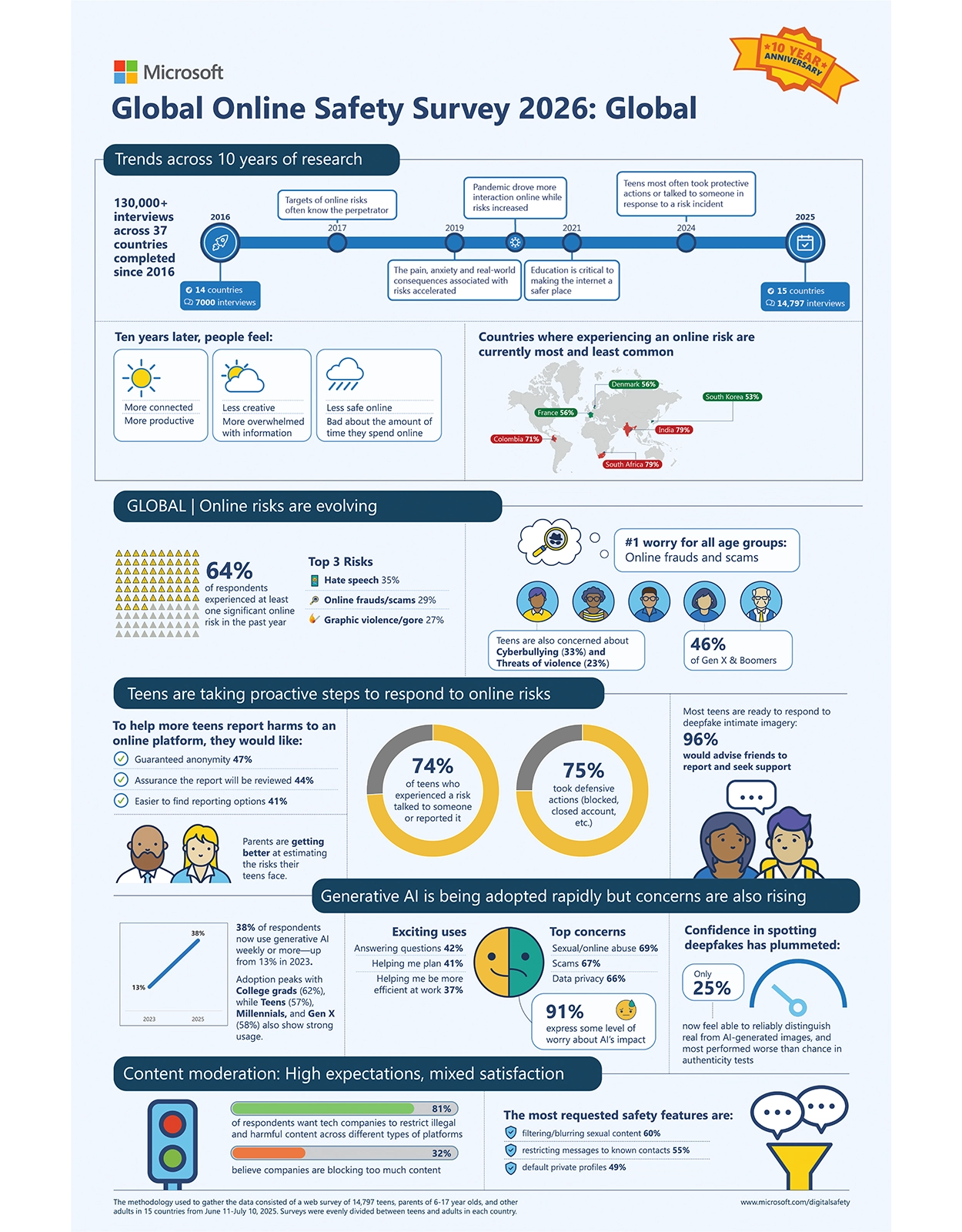
What the 2026 Global Online Safety Survey Reveals
According to Microsoft’s 2026 Global Online Safety Survey, 67% of respondents reported being exposed to harmful or offensive material online. Among teens aged 13 to 17, that number climbs to 70%.
The most common experiences included misinformation and disinformation. But many teens also reported more personal harms: cyberbullying, harassment, hate speech, and even threats of violence.
These encounters do not simply fade when the screen goes dark. Research shows that harmful online experiences can leave teens feeling less trusting of others, struggling with sleep, and experiencing lower self-esteem. Nearly 41% of teens surveyed expressed concern about cyberbullying and harassment — a higher level of worry than adults reported.
Digital harm can take many forms:
- Exposure to age-inappropriate content
- Bullying and hate speech being amplified by anonymity
- Grooming and unwanted contact from strangers or even acquaintances
- Sextortion, where young people are threatened with the release of private images
Reality may be sobering, but it’s here. And the only way to make the internet a safer place is to know the battlefield. Online safety is no longer about restricting access. It is about equipping young people with discernment, resilience, and the assurance that when something feels wrong, they can come to us — and we will listen.

7 Ways to Raise Digitally Resilient Kids (Without Panic)
If the internet is now part of childhood, then digital parenting has become part of everyday parenting. The goal isn’t to hover over every click. It’s to guide, prepare, and stay connected.
Here’s how families can build safer, smarter online habits together:
1. Start Early — and Keep the Conversation Going
Digital safety shouldn’t begin when something goes wrong. Ask younger children what they’re watching, playing, and exploring. Go online with them. As they grow older, shift from monitoring to mentoring.
Teens are more likely to open up when they feel trusted, not interrogated. Use activity summaries or trending topics as conversation starters — not surveillance reports.
2. Co-Create Boundaries, Don’t Just Enforce Them
Rules land better when children help shape them. Talk about screen time, app downloads, gaming limits, and online purchases. Discuss why boundaries exist.
When children understand the reasoning behind rules, they’re more likely to respect them. For teens, this becomes an evolving dialogue rather than a rigid checklist.
3. Know the Platforms They Use
You don’t have to master every app — but familiarity matters. Explore the games they love. Check privacy settings together. Discuss in-app purchases and age restrictions before devices are even bought.
For younger children, keep internet-connected devices in shared family spaces. Visibility builds safety — and opens space for casual, natural conversations.
4. Teach Them to Protect Their Data
Explain what “personal information” means — and why it has value. Help them create strong passwords. Remind them that passwords are not for sharing, even with best friends.
A simple rule works at any age: STOP. THINK. CLICK (or not). If something feels too urgent, too exciting, or too good to be true, IGNORE. We call this the “Zero Trust Policy.”
5. Make Privacy a Family Habit
Every platform has privacy settings. Learn them. Adjust them. Review them periodically.
Talk about who can see posts, photos, and location data. Make it normal to ask, “Who will see this?” before sharing anything online.
6. Model Digital Civility
Children watch how we behave online. If we engage in harsh comments or heated arguments, they absorb that tone.
Remind them: if it wouldn’t be kind face-to-face, it isn’t kind online. Empathy travels. So does cruelty. Let’s choose which one we amplify.
7. Encourage Questions — Especially About What They See
Not everything online is true. Help your child distinguish fact from opinion, misinformation from deliberate deception.
Ask them:
- Who created this?
- What might their goal be?
- Is there another source confirming this?
Critical thinking is one of the most powerful safety tools we can give them.
So what do we do now?
We often believed that prevention and banning were the best way to go. It would make sense to take out the trash; we go for the source. But in a world that’s automated and has a lot of technology, we can’t completely ban them. The only thing we can teach kids and teens is how to survive and thrive in a digital world.
That knowledge has to come from us. We’ve experienced the world when technology was still taking its baby steps. Because if our kids don’t learn how the technology started, how else are they going to predict how it’ll evolve and learn how to use it?
Frequently Asked Question
Earlier than most parents think — and more casually than most imagine.
Digital safety isn’t a single “big talk.” It’s a series of small, steady conversations that grow with your child. If they’re old enough to swipe a screen, they’re old enough for simple rules about privacy, kindness, and asking before sharing. As they mature, those lessons evolve into deeper discussions about misinformation, peer pressure, and digital footprints.
Start small. Stay consistent. Keep it normal.
Think guidance, not surveillance.
Younger children need more structure — shared spaces, parental controls, device-free bedrooms. Teens, however, benefit from collaboration. Instead of secretly checking devices, agree on boundaries together and explain the reasoning behind them.
When children feel trusted, they’re far more likely to come to you when something feels off. Safety built on trust lasts longer than safety built on fear.
Pause before you panic.
Your reaction teaches them how safe it is to tell you the next time something happens. Stay calm. Ask what they saw and how it made them feel. Reassure them they’re not in trouble.
Then use it as a teachable moment: review privacy settings, reporting tools, and how to exit uncomfortable situations online. Mistakes — and unexpected exposure — are opportunities to strengthen resilience, not reasons for shame.
Curiosity is your greatest ally.
Instead of delivering lectures, ask questions:
Who created this?
Why might they have made it?
Is there another source confirming it?
When children learn to pause and question rather than react and share, they build a habit that protects them long-term. Critical thinking isn’t just a school skill — it’s a survival skill in the digital age.
You don’t need to be an expert in every app.
You need to be present.
Ask your child to show you what they’re using. Let them teach you. That role reversal builds confidence for them and insight for you. The goal isn’t to master every platform — it’s to stay connected.
Technology changes quickly. Relationship doesn’t have to.
More about digital wellness and online safety?
Instagram Releases a Parents’ Guide For Online Safety
How YouTube Strengthens Parental Authority in The Digital Space
10 Commandments for Every Kid and Teen Netizen