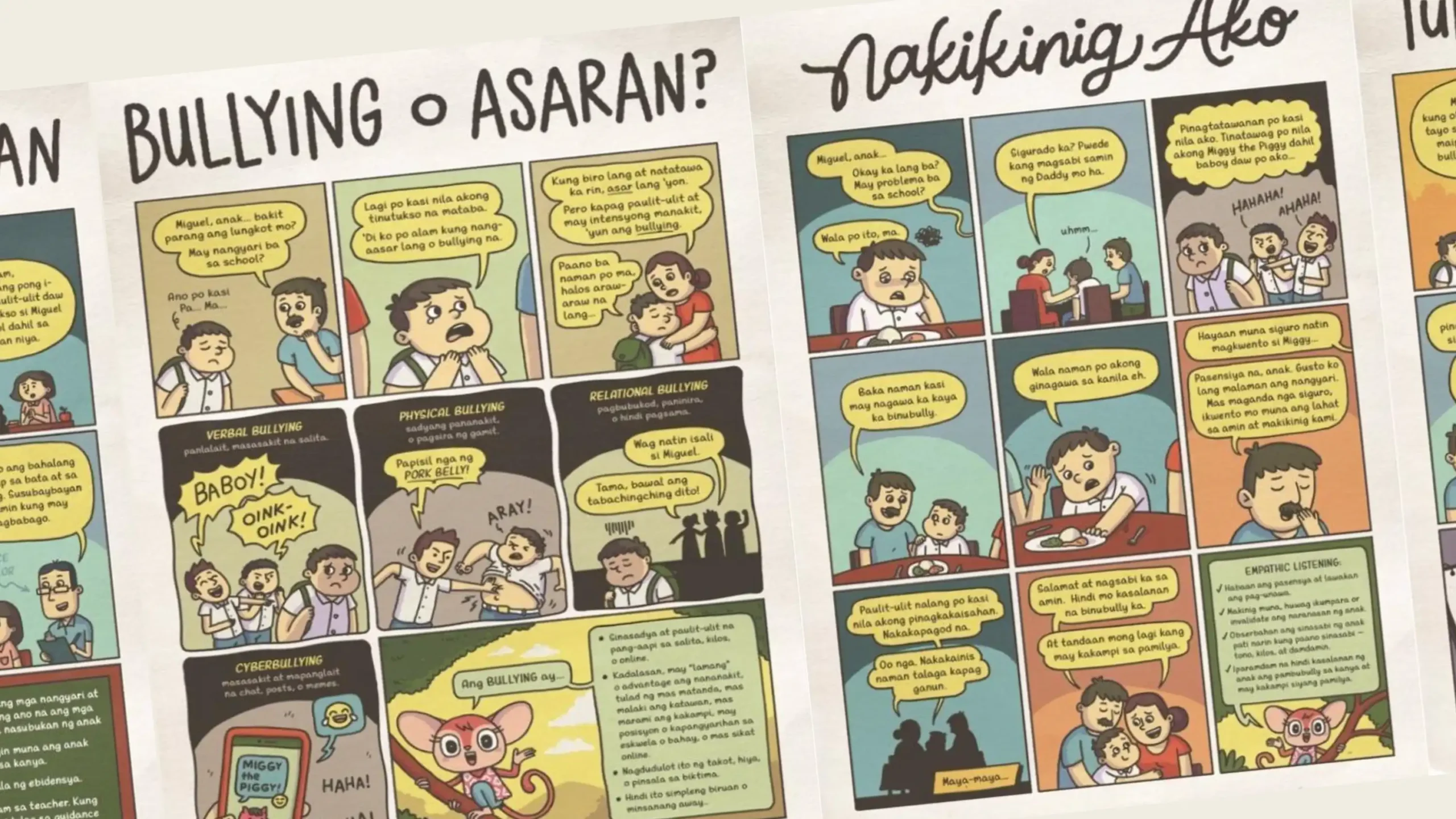
Safer Screens: A Parent’s Guide to Kids’ Online Safety Part I



What a viral AI privacy scandal and real Philippine OSEC cases reveal about the dangers kids face online
Note: This is a two part series
Kalie Robins didn’t think twice about posting a video of herself singing with her daughter in the car. It’s the kind of clip hundred of thousands of parents post every week. Then Facebook’s Meta AI dropped a suggested question underneath it: “Who is the child passenger?“
She clicked, more out of confusion than concern. What came back unsettled her. The system pulled up separate details for each of her children — names, birth dates, videos — including a photo of her newborn that her own mother had posted years earlier, and a picture Robins said she’d long since deleted from her own account. A second prompt asked where she lived. According to later reporting, the AI had already assembled her daughters’ names, ages, birth weights, grades, home location and both parents’ employers from years of scattered Instagram and Facebook posts, some of them not even her own.
Meta told reporters the prompts “missed the mark” and should never have appeared, and said the issue behind them had been fixed. But the story, which went viral in early September, landed hard with parents who assumed a stray photo from years back was long forgotten. It wasn’t. It was sitting in a database, waiting for a system smart enough to connect the dots.
That’s the online world kids globally are growing up in now — one where the risk isn’t only a stranger in a chatroom, but the quiet, cumulative trail every device and every well-meaning adult leaves behind.
A digital childhood comes with digital risks
A child’s online world can be a place to learn, play and connect. It can also expose them to scams, cyberbullying, privacy violations, grooming and sexual exploitation — and, as Robins found out, to AI systems built to notice patterns nobody asked them to look for.
How grooming actually works
Grooming remains the danger parents fear most. A stranger poses as a fellow gamer or even another child, builds trust slowly, then asks for personal details, pushes the chat to a private platform, or pressures a child to send photos. It’s patient and deliberate, which is exactly why it’s easy to miss until it’s already underway.
What the law says
Philippine law has a name for this and a serious response to match. Republic Act No. 11930, the Anti-Online Sexual Abuse or Exploitation of Children and Anti-Child Sexual Abuse or Exploitation Materials Act, covers grooming, luring, sexual extortion, image-based sexual abuse and livestreamed abuse — and states plainly that a child’s consent never excuses these offenses, closing off exactly the manipulation groomers rely on.
Then there’s the more everyday harm: phishing links, fake giveaways, account takeovers and cyberbullying, which UNICEF defines as bullying carried out through social media, messaging apps and gaming platforms rather than the schoolyard.
It’s not hypothetical — recent Philippine cases
None of this is abstract here. The Philippines is repeatedly flagged as one of the largest known sources of livestreamed child sexual abuse in the world.
The numbers behind the headlines
International Justice Mission data puts the median victim age at 11, with roughly 1 in every 100 Filipino children affected by online sexual exploitation in 2022, and 83% of traffickers turning out to be family members rather than strangers. A separate 2022 study estimated about 2 million Filipino children were affected in the previous year alone; a Commission on Human Rights report put the figure closer to 2.7 million by the end of 2023.
Cases that made the headlines
In September 2025, the National Bureau of Investigation‘s Human Trafficking Division arrested a Quezon City woman after a tip from Canadian police traced back to a Skype account. She had allegedly been paid to livestream the sexual abuse of her own 12-year-old daughter, uncovered through the Philippine Internet Crimes Against Children Center, a task force built for exactly this kind of cross-border case.
In June 2026, the PNP’s Women and Children Protection Center ran two operations days apart, in Zamboanga City and in Norzagaray, Bulacan, arresting two women and rescuing seven minors aged 11 to 16 from what investigators described as abuse-material production for paying clients overseas.
And in Pateros, a mother and her adult daughter were convicted in 2023 and given life sentences for trafficking the mother’s own young granddaughters, one of more than 170 Philippine convictions International Justice Mission says it has helped secure.
The Commission on Human Rights report flags something worth sitting with: poverty is a primary driver, and a large share of cases involve family members or close relatives rather than the anonymous predator most parents picture.
When cyberbullying turns fatal
Cyberbullying carries its own local weight. Research tied to the National Baseline Survey on Violence Against Children found that cyberviolence affects close to half of Filipino children aged 13 to 17, with no meaningful gap between boys and girls.
And 2025 put a painfully public face on the toll it can take: 19-year-old content creator Emman Atienza, who had spoken openly about the dread that came with every post, died by suicide after years of visible online harassment — a case that pushed lawmakers to draft what’s informally called the Emman Atienza Bill, aimed at criminalizing malicious online harassment more broadly. She was 19, not a minor, but her case is a hard reminder of what unchecked harassment does to a young person who grew up entirely online — the same internet today’s kids are joining.
None of these cases involve some exotic, hard-to-spot danger. They involve ordinary platforms, ordinary posts and, distressingly often, people the child already knew.

Who’s actually watching out for Filipino kids online
Several agencies share the job, each with a different lane.
The Department of Information and Communications Technology, working with the Cybercrime Investigation and Coordinating Center, handles cybersecurity coordination with platforms and internet service providers and has issued its own Child Online Safeguarding Policy.
The Department of Justice’s Office of Cybercrime leads investigations, prosecutions and cross-border requests to preserve digital evidence. RA 11930 itself puts real obligations on tech companies: internet intermediaries and service providers must prevent, detect, block and report online sexual abuse and exploitation, with high-privacy settings for minors required as the default wherever practicable.
The National Privacy Commission administers the Data Privacy Act of 2012 and has issued child-specific transparency guidelines requiring extra protection whenever organizations process a minor’s personal data — a rule that reads differently in light of what Meta AI just showed it can quietly stitch together from years of public posts.
Where to get help
For families who need help now, the Department of Social Welfare and Development and the Council for the Welfare of Children run the MAKABATA Helpline at 1383 for abuse cases, emergencies, referrals and psychosocial support.
A note on sensitive content: this piece references suicide and child sexual abuse in a factual, informational context. If you or someone you know is struggling, the National Center for Mental Health crisis hotline (1553/ 0917-899-8727/0966-351-4518/0919-057-1553/ 1800-1888-1553) and the MAKABATA Helpline (1383) are both available.
Next: What parents and guardians can actually do about it — from account settings to the habits that keep kids one step ahead. Read Part 2.
Frequently Asked Questions
Even routine posts can contribute to a cumulative digital footprint. Advanced tools like Meta AI can cross-reference years of scattered posts, photos (including long-deleted ones or those posted by relatives), and location tags to construct detailed profiles containing a child’s full name, birth date, school grade, home location, and parents’ employers.
The article categorizes risks into several main areas:
Privacy and AI Data Harvesting: Automatic tracking and aggregation of children’s personal information.
Grooming: Adults posing as peers or authority figures to build trust, isolate, and exploit children.
Online Sexual Abuse and Exploitation (OSEC): Extortion, image-based abuse, and live streaming of abuse.
Cyberbullying & Harassment: Targeted harassment across gaming platforms, messaging apps, and social networks.
Cyber Scams: Phishing links, fake giveaways, and account takeovers.
Grooming is a slow, deliberate process where a predator usually poses as a peer or fellow gamer. They gradually gain the child’s trust, encourage them to move conversations to private channels, ask for sensitive personal details, and eventually pressure them into sending explicit images or performing acts on camera.
Under Republic Act No. 11930 (Anti-Online Sexual Abuse or Exploitation of Children Act), a child’s legal consent never excuses or mitigates these offenses. The law strictly covers grooming, luring, sexual extortion, image-based abuse, and livestreamed abuse, ensuring perpetrators cannot claim the minor agreed to the interaction.
Research estimates indicate that over 1 million to 2.7 million Filipino children have been affected by online sexual exploitation.
Data from International Justice Mission (IJM) shows the median victim age is 11 years old.
Crucially, 83% of traffickers are family members or close relatives rather than anonymous online strangers, frequently driven by financial poverty.
Data connected to the National Baseline Survey on Violence Against Children reveals that cyberviolence impacts nearly half (approx. 50%) of Filipino teenagers aged 13 to 17, affecting boys and girls equally.
Following the high-profile death of 19-year-old content creator Emman Atienza after years of persistent online harassment, lawmakers drafted the “Emman Atienza Bill” to legally define and criminalize malicious online harassment more broadly.
Families can reach out to the MAKABATA Helpline at 1383 (run by the DSWD and the Council for the Welfare of Children) for immediate intervention, emergency response, case referrals, and psychosocial support.
More on cybersecurity and cyberbullying issues
Why It’s Important to Protect the Elderly Online
When “Too Good to Be True” Costs Families Everything
How Families Can Protect Themselves From Online Scams